The Most Haunted Places in Savannah, Georgia
The real history behind Savannah's haunted reputation, the Marshall House's documented past, and the stops ghost tours visit, with an honest bridge to sunset riverboat cruises.
The Most Haunted Places in Savannah, Georgia
Savannah's most haunted places trace back to documented events: the 1779 Siege of Savannah killed over 800 people, yellow fever epidemics in 1820 and 1854 killed roughly 700 and more than 1,000 residents respectively, and destructive fires in 1796 and 1820 reshaped whole blocks. The Marshall House, Colonial Park Cemetery, the Mercer House, and the old Candler Hospital morgue tunnels anchor most ghost tours today, and each has a real history behind its ghost stories.
The city's nickname, "America's most haunted city," is not marketing invention. It rests on a density of real 18th- and 19th-century tragedy packed into two square miles of Historic District. Mass graves sit beneath Colonial Park Cemetery, where yellow fever victims were buried in trenches during the 1820 epidemic. A battlefield lies under and around the squares where the 1779 Siege of Savannah played out. And the riverfront that made the city wealthy, the same stretch where Savannah River Cruises departs today, was a hub of the transatlantic slave trade, a history the city has only recently begun marking in earnest with the African American Monument on River Street.
That last point matters for honest ghost tourism. Much of what tours narrate is not spook-story embellishment but grief with a paper trail: property records, hospital logs, newspaper death counts. The Georgia Encyclopedia's entry on Savannah documents the epidemics, the fires, and the port history that ghost tours compress into ninety-minute walking routes.
If you are planning a trip around haunted Savannah, the practical choices are a walking tour, a trolley tour, or a hearse tour, all covered in detail in the site's guide to Savannah ghost tours. A quieter complement is simply being on the river at dusk, which is where this site's cruises come in, and we will get to that honestly at the end.
Why does Savannah have such a strong haunted reputation?
Savannah earned its haunted reputation through four documented catastrophes: the 1779 Siege of Savannah with more than 800 casualties, the 1820 yellow fever epidemic that killed roughly 700 people in a city of 5,000 to 7,000, the 1854 epidemic that killed more than 1,000, and major fires in 1796 and 1820. Layered over all of it is the city's role as a major transatlantic slave-trade port, which left unmarked graves and unrecorded suffering across the downtown.
Start with the siege. In October 1779, a combined French and American force attacked British-held Savannah and was repelled with catastrophic losses, over 800 casualties in a single morning, including Count Casimir Pulaski. The wounded died in buildings that still stand near Franklin Square, and mass burials followed. Ghost tours that stop in the squares around City Market are, in effect, standing on a battlefield.
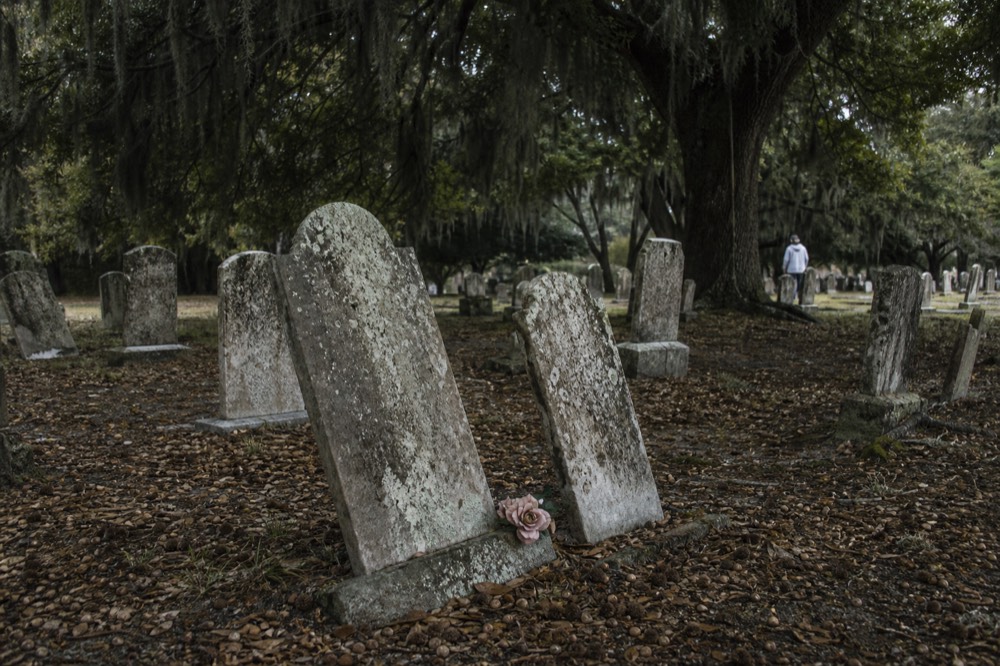
Yellow fever did the deeper damage. The 1820 epidemic killed an estimated 700 people in a city whose entire population was somewhere between 5,000 and 7,000, a mortality shock that is hard to overstate. The 1854 epidemic was worse in absolute numbers, with more than 1,000 deaths. Colonial Park Cemetery holds trench graves from these years, and several tour operators point out headstones whose dates cluster suspiciously in epidemic years. Fires in 1796 and 1820 destroyed large sections of the city and killed residents who, in some tellings, never entirely left the rebuilt blocks.
The slave-trade history is the part that some tours handle well and others rush. Savannah was one of the busiest ports in the antebellum South, and the human cargo that passed through its docks died in the city in numbers no one recorded precisely. The African American Monument on River Street names this history directly. When a tour mentions "unmarked graves" downtown, this is often what is being referenced, and it deserves more gravity than a jump scare.
| Event | Year | Documented toll | Haunted legacy today |
|---|---|---|---|
| Siege of Savannah | 1779 | 800+ casualties | Battlefield squares, Franklin Square area stops |
| Great fire | 1796 | Large sections of the city destroyed | Rebuilt blocks on tour routes |
| Yellow fever epidemic | 1820 | ~700 deaths in a city of 5,000-7,000 | Colonial Park Cemetery trench graves |
| Second great fire | 1820 | City again heavily damaged | "Never left the rebuilt blocks" stories |
| Yellow fever epidemic | 1854 | 1,000+ deaths | Mass graves, hospital sites including the Marshall House |
| Transatlantic slave trade | Antebellum era | Unrecorded deaths | African American Monument, unmarked-grave references |
None of this requires a belief in ghosts. The reputation persists because the history is unusually visible: Savannah never paved over its cemeteries or pulled down its hospital buildings the way most growing cities did. The dead are still physically present in the urban landscape, which is a rare thing in an American downtown.
The Marshall House: the most documented haunted hotel in Savannah
The Marshall House, built in 1851 on Broughton Street, is Savannah's most credible haunted hotel because its ghost stories attach to verifiable history: it served as a hospital during the Union occupation of 1864-65 and again during the yellow fever epidemics. Guests today report apparitions in hallways, the sound of children running at night, and faucets that turn on by themselves, and the hotel documents these claims on its own website.
What separates the Marshall House from every other "haunted hotel" claim in the city is the paper trail. The building's hospital use during the Civil War occupation and the epidemics is established history, not tour-operator lore. Amputations happened here. People died here in numbers, during both the war and the fever years. The hotel's own haunted history page publishes guest accounts of apparitions in the halls and foyers, children's footsteps at night, and faucets turning on unassisted, and the property has been featured on Travel Channel programs about haunted hotels.
The hotel leans into it honestly, which is itself informative. Rather than denying the stories, the Marshall House treats them as part of the building's documented past. Guests who stay there are, in effect, sleeping in a former military hospital, and the hotel says so. For a deeper look at the building's timeline and the specific claims, the site's piece on the Marshall House and its haunted history walks through the records year by year.
The Marshall House is also a useful calibration point for the rest of the city's ghost claims. If a hotel with this much documented tragedy reports this specific a set of experiences, you can compare other claims against that standard. A square with a mass grave nearby is plausible haunted ground. A restaurant with a story that conveniently omits its building's actual age is less so.
More haunted stops, and the tours that visit them
Beyond the Marshall House, the stops that anchor Savannah's ghost tours are the Mercer House on Monterey Square, the Espy House, the old Candler Hospital morgue tunnels, Taylor and Calhoun squares, the Andrew Low House, and the Perkins and Sons Ship Chandlery on River Street. Three established operators, Sixth Sense, Ghosts and Gravestones, and Hearse Ghost Tours, cover these sites on foot, by trolley, and by converted hearse respectively.
The Mercer House, later famous through the book "Midnight in the Garden of Good and Evil," is a regular walking-tour stop. The Espy House and the old Candler Hospital morgue tunnels appear on Sixth Sense's route, and the tunnels in particular are the kind of physical relic that makes Savannah's ghost stories feel grounded: an actual morgue, beneath an actual hospital, from the actual epidemic years. Ghosts and Gravestones adds exclusive nighttime walking entry to the Andrew Low House and the Perkins and Sons Ship Chandlery on River Street, which is one of the few ways to get inside a haunted building after dark rather than staring at it from the sidewalk.
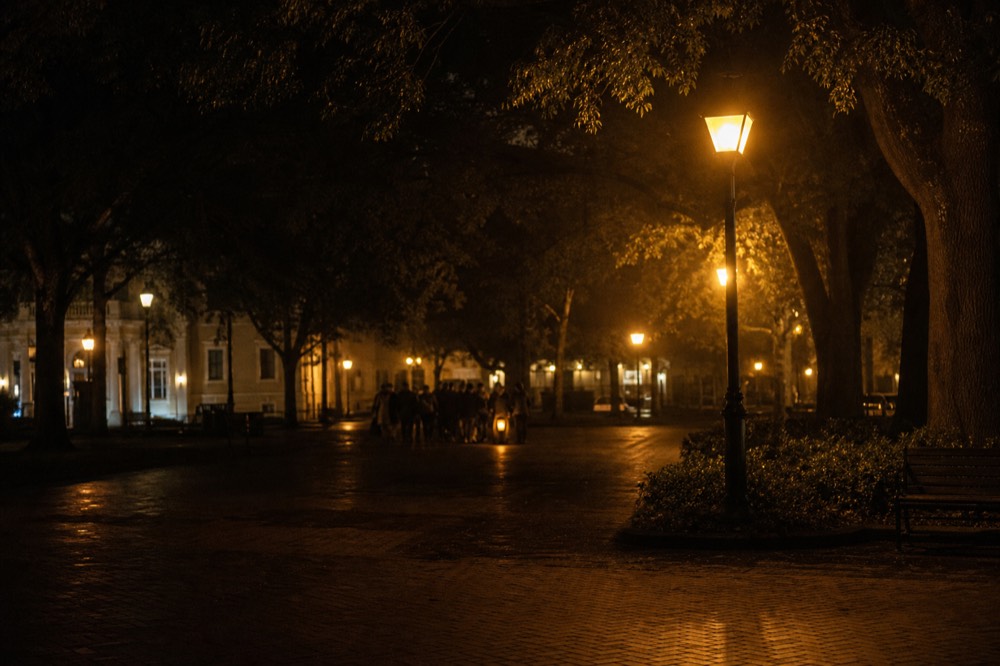
Choosing among the operators comes down to format and audience. Walking tours get you closest to the buildings and run the longest. The trolley covers more ground and is rated PG-13, with no children under 7. The hearse tours are the oddity: real converted funeral vehicles, up to 8 passengers each, running nearly nightly year-round.
| Operator | Format | Duration | Key stops | Price (checked September 2026) |
|---|---|---|---|---|
| Sixth Sense Ghost Tour | Walking, up to 1 mile | 2 hours | Mercer House, Espy House, Candler morgue tunnels, Taylor/Calhoun Square | $36 (checked September 2026) adult, $32 youth/military/senior |
| Ghosts and Gravestones | Narrated trolley, "Trolley of the Doomed" | 1 hour 15 minutes | Cemeteries, mansions, Andrew Low House, Perkins and Sons Ship Chandlery | Roughly $42-48 (checked September 2026) adult |
| Hearse Ghost Tours | Converted hearses, up to 8 passengers | 75 or 90 minutes | Historic District squares, cemeteries, haunted sites | On the operator's live listing |
Sixth Sense runs all-ages time slots plus 16-and-over-only departures, so check the time slot carefully when booking if you are traveling with children. Ghosts and Gravestones departs from 301 East River Street, steps from where the riverboats dock, which makes it easy to pair a trolley ghost tour with an evening on the water. Routes, ratings, and booking details for all three operators are compared in the site's ghost-tour guide, which is linked at the top of this page.
Can you see haunted Savannah from the water at dusk?
You cannot take a ghost cruise from this site, and it is worth being direct about that. What you can do is be on the Savannah River at dusk, passing the River Street cotton warehouses, the Waving Girl statue, and the route toward Old Fort Jackson, while the gas lamps come on along the waterfront. The sunset riverboat cruise is an honest pairing with a walking ghost tour earlier in the evening.
The pairing works because of geography. Ghost tours concentrate in the blocks just uphill from the river, and the riverfront itself, the old King Cotton warehouses, Factors Walk, and the slave-trade sites along the water, is where much of the underlying history actually happened. A sunset cruise puts you on the water that carried all of it: the cotton, the fever ships, the enslaved people, and the trade that built the warehouses. None of that is a ghost story, and no cruise on this site is marketed as one.
The sunset riverboat cruise runs from $55.05 per person (checked September 2026), rates 4.3 stars from 800 reviews (checked September 2026), and carries free cancellation up to 24 hours before, which matters if your ghost tour runs long and you want to shift the timing. Reviewer commentary on the sunset sailings consistently highlights the golden-hour light on the river and the atmosphere aboard, with the sun dropping behind the Talmadge Bridge as the boat turns downriver.
If you would rather make a full evening of it, the dinner cruise with live entertainment is the other water-based option that pairs well with a haunted itinerary. It sails Sunday through Friday, boarding at 6pm and sailing at 7pm, returns at 9pm, and runs from $92.52 per person (checked September 2026), with a Southern buffet and live entertainment aboard. It often sells out, so booking ahead is the practical advice, and it carries free cancellation. It is a dinner show, not a séance, but a 2-hour evening on the river after a ghost walk is a defensible way to end the day.
For help deciding whether the water or the walking tour deserves the prime evening slot, the site's comparison of a ghost tour versus a river cruise lays out the trade-offs by budget and schedule.
The questions below cover the stops, the tours, and the honest limits of what a river cruise can add to a haunted Savannah itinerary: which sites are most cited, why the city earned its reputation, which operators suit families, and what the water-based options actually are.
Common questions about Savannah's haunted places
The Most Haunted Places in Savannah, Georgia
The Marshall House, Colonial Park Cemetery, the Mercer House, the old Candler Hospital morgue tunnels, and the River Street waterfront are the most cited stops. Each ties to documented history: the 1779 Siege of Savannah, the 1820 and 1854 yellow fever epidemics, the 1796 and 1820 fires, and the city's slave-trade past.
Is the Marshall House really haunted?
It is the most credible haunted hotel in Savannah because its stories attach to verified history. Built in 1851, it served as a hospital during the Union occupation of 1864-65 and during the yellow fever epidemics. Guests report apparitions, children's footsteps at night, and faucets turning on by themselves, and the hotel publishes these accounts itself.
Why is Savannah called the most haunted city in America?
Because its tragedies are unusually well preserved and unusually dense. Over 800 casualties in the 1779 siege, roughly 700 yellow fever deaths in 1820 in a city of 5,000 to 7,000, more than 1,000 deaths in the 1854 epidemic, two destructive fires, and a major slave-trade port all left graves and sites inside two square miles that were never redeveloped away.
Which Savannah ghost tour visits the most haunted sites?
Sixth Sense's 2-hour walking tour covers the Mercer House, the Espy House, the Candler Hospital morgue tunnels, and Taylor/Calhoun Square for $36 per adult (checked September 2026). Ghosts and Gravestones adds exclusive nighttime entry to the Andrew Low House and the Perkins and Sons Ship Chandlery on its trolley tour.
Is there a ghost boat cruise in Savannah?
Not among the cruises sold on this site, and this site does not claim otherwise. A seasonal sunset ghost boat tour run by an independent operator exists in the area but is booked directly, not through these listings. The honest water-based option here is a sunset riverboat cruise, which is an atmospheric evening on the river, not a ghost experience.
Can children go on Savannah ghost tours?
It depends on the operator. Sixth Sense runs all-ages departures plus 16-and-over-only slots. Hearse Ghost Tours is family-friendly and runs nearly nightly. Ghosts and Gravestones is rated PG-13 and does not allow children under 7.